Siding, Stucco, or Brick: How House Washing Differs for Milton Homes
Short answer: In Milton, Pace, East Milton, and Bagdad, vinyl, stucco, brick, Hardie board, and painted wood are washed with low pressure and a cleaning solution, not with the pressure used on a driveway. The green or black film on a shaded north wall is mildew or algae, and early winter along this stretch of the Gulf Coast does not dry it off.
In Milton, Pace, East Milton, and Bagdad, vinyl, stucco, brick, Hardie board, and painted wood are washed with low pressure and a cleaning solution, not with the pressure used on a driveway. The green or black film on a shaded north wall is mildew or algae, and early winter along this stretch of the Gulf Coast does not dry it off.
Why a North Wall Stays Green Into Winter
Homes in Pace and homes booked for pressure washing in Milton sit in Santa Rosa County, inland of the Gulf. NOAA's state climate summary describes this Gulf Coast climate, from its subtropical latitude and the nearby Gulf, as hot, humid summers and mild winters.
NOAA's 1991–2020 climate normals for the Milton Experiment Station (USC00085793) put November's average high at 69.8°F and normal rainfall at 4.81 inches. December's average high is 62.7°F, with 4.61 inches of rain. January's average high is 60.2°F, the average low is 36.0°F, and normal rainfall is 5.89 inches. Those are 30-year normals, not a forecast. A north wall under pines or oaks misses the sun that dries the south side.
University of Florida IFAS publication HE887 says warm weather and heavy seasonal rains let algae and mildew thrive, and that plantings should sit three feet or more off a wall so air can move. The National Park Service, in Preservation Brief 10, says mildew on paint thrives on the north side and in shade near shrubbery. Scheduling before holiday company is covered in fall and winter pressure washing in Pace and Milton.
What the Green and the Black Are
James Hardie's cleaning bulletin says mildew can look like dirt. Moisture is the main factor, it can lie dormant for years, and it shows in damp, dark areas during long humid spells. Georgia-Pacific's vinyl care page says mildew normally appears as black spots, often under eaves and porches that rain misses.
On paint, Preservation Brief 10 calls mildew a fungus that feeds on the paint film or on dirt. A drop of household bleach turns mildew white. Dirt does not. Use that drop only to tell mildew from dirt. On masonry that stays wet, Brick Industry Association Technical Note 20 lists moss, algae, lichen, and other organic growth. Sto's guide for acrylic finishes calls green stains algae and black, dirt-like stains mildew. Shade, pines, oaks, and a sprinkler can bring a film back.
Why the Walls Get a Soft Wash
A soft wash is the method for house washing in Milton. It puts a cleaning solution on the growth, lets it work, and rinses at low pressure. High pressure is what fails the wall: water under vinyl laps, a stream on stucco, mortar cut from brick, or water forced into painted wood.
Vinyl
The Vinyl Siding Institute's 2020 installation manual starts with rain or a garden hose, then a soft car-washing brush if the wall is still dirty. For grime it lists 1/3 cup powder detergent, 2/3 cup powder household cleaner, and 1 gallon of water. For mildew, add 1 quart of liquid laundry bleach. Wash from the bottom up so runoff does not streak, and keep the cleaner off shrubs. The manual does not publish a pressure-washer setting.
Georgia-Pacific, for its own vinyl, says to hold the washer at eye level and not aim it upward. Water may collect behind the siding, then leak and streak, or stay there and cause decay. The published range is 1,500 to 2,400 psi with a 40-degree tip: a level fan, not a stream under the laps. Vinyl and stucco are the walls we see on newer streets in Pace and east and north of Milton.
Stucco
Portland cement plaster and an acrylic finish do not share a pressure number.
The Stucco Manufacturers Association's care sheet for portland cement plaster says to pre-wet from the bottom up, wash from the top down with a garden hose, and use a mild cleaner that will not attack portland cement, lime, or oxide pigments. A jet nozzle can clean. Held too close, the stream may erode the finish. The sheet gives no psi number. Sto's repair notes cite the Portland Cement Association's Portland Cement Plaster (Stucco) Manual for why cement stucco cracks. That manual is not a pressure limit.
On acrylic and acrylic elastomeric finishes, Sto's maintenance guide keeps a washer at about 200 to 500 psi, with the nozzle several feet off the wall, and says pressure above 500 psi can destroy the finish. A bleach mix needs about 15 minutes of contact or, Sto says, the algae and mildew come back. That 500 psi cap is for those finishes only.
Brick
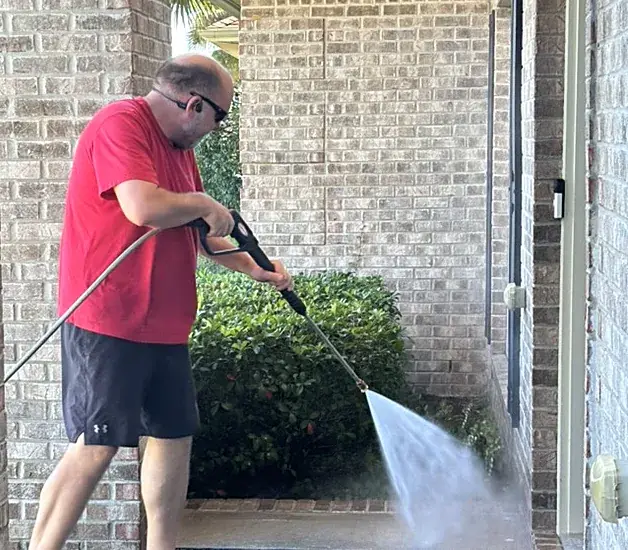
Technical Note 20 (August 2018) says to consult the brick manufacturer before using pressurized water. Excessive pressure may damage the brick face, erode mortar joints, and remove a coating. High pressure, greater than 800 psi at the nozzle tip, is not appropriate for brick. Use a 25- to 50-degree fan at least 12 inches off the wall. Medium pressure, 400 to 800 psi, is only if the manufacturer allows it. Moss, algae, and lichen show up on masonry that stays damp, which fits a shaded brick wall under oaks in Milton.
Painted Wood
Painted wood is common on older Milton houses, including near the historic district. Preservation Brief 10 calls a detergent solution, a medium-soft brush, and a garden-hose rinse the gentlest wash. It does not recommend waterblasting above 600 psi to remove paint, because that can force water into the wood, and at worst through the sheathing.
Hardie Board
James Hardie Technical Bulletin 20 (November 2018) covers primed siding and ColorPlus. Low-pressure spray and a soft nonmetal brush are most suitable. If a washer is used, a wide fan stays at least six feet off the wall and under 1,500 psi. Sandblasting and acid washing are not recommended. Damage from improper cleaning may not be covered by the James Hardie warranty.
What to Ask, and What to Do First
Ask for a soft wash on each material, with the vinyl rinse kept level rather than up under the laps. Ask what is in the tank. A vinyl mildew mix is the wrong mix for painted wood, and a stucco cleaner has to leave portland cement, lime, and oxide colors alone. Protect shrubs before any cleaner goes on. Ask for proof of liability insurance, and send a photo from the yard.
Close the windows and move grills and cushions off the wall. Say if one side is vinyl and an addition is Hardie, and if a sprinkler hits the same wall each morning. Point out peeling paint, cracked stucco, or loose mortar. A wash does not repair them.
What It Costs
Most house washing jobs in the Pace area run between $300 and $800 depending on home size, the level of buildup, and the number of stories. That is the range on the house washing page, and the page lists the same pricing for Milton. What moves the number, including a second story and heavy growth, is in how much house washing costs in Milton and Pace. It is not a price for a house we have not seen.
Questions About Washing Different Siding
How should vinyl, stucco, brick, Hardie, and painted wood be washed?
With low pressure and a cleaning solution matched to the material. Vinyl starts with a hose and a soft brush. A close stream may erode portland cement plaster. Keep brick at or under 800 psi at the nozzle, and keep fiber cement under 1,500 psi with the fan at least six feet off the wall. Painted wood gets a garden-hose rinse, not a blast above 600 psi.
Why does the north wall stay green or black in winter?
It stays damp. NOAA's 1991-2020 normals at the Milton Experiment Station show 4.81 inches of rain in November, 4.61 in December, and 5.89 in January, with a January average high of 60.2°F. Pines and oaks block the sun. UF/IFAS says warm rains let algae and mildew thrive on a house exterior.
What does high pressure do to siding?
Georgia-Pacific says an upward stream can leave water behind vinyl, where it may leak, streak, or cause decay. A close nozzle may erode cement plaster, and Sto says pressure above 500 psi can destroy an acrylic finish. Excessive pressure may erode brick mortar, and waterblasting above 600 psi can force water into painted wood.
What should I have ready before a house wash?
The siding on each side, whether stucco is cement plaster or an acrylic finish, and a photo of the green or black wall. Close the windows. Call or text (850) 845-9110.
How much does house washing cost in Milton and Pace?
Most house washing jobs in the Pace area run between $300 and $800, depending on size, buildup, and stories. That range is on our house washing page. It is not a price for a house we have not seen.
Get a Quote
Call or text (850) 845-9110 or Get a Quote. Name the siding and send a photo of the green or black side. We wash houses in Milton, Pace, East Milton, and Bagdad.